For Federal Agency Facility Managers and Contractors operating government buildings in Puerto Rico, the phrase “audit readiness” is not just a goal; it is a constant state of being. A Federal facility audit, whether conducted by the General Services Administration (GSA), an Office of Inspector General (OIG), or a third-party assessor, is a meticulous, top-to-bottom review of every aspect of your operation.
It is an intense examination of your facility’s health, safety, efficiency, and, above all, your compliance with a vast and complex web of federal mandates.
Failing an audit can have severe consequences, from budget reallocations and documented deficiencies to contractual penalties. Conversely, a successful audit is a powerful validation of your operational excellence and diligent stewardship of taxpayer-funded assets.
The key to success is not a last-minute scramble; it is a year-round commitment to proactive maintenance, meticulous documentation, and a culture of compliance.
At MASE, we are more than a facilities management provider; we are your strategic partners in achieving and maintaining a constant state of audit readiness. With our deep experience working with DoD, GSA, and civil agencies on the island, we understand the specific criteria that auditors scrutinize.
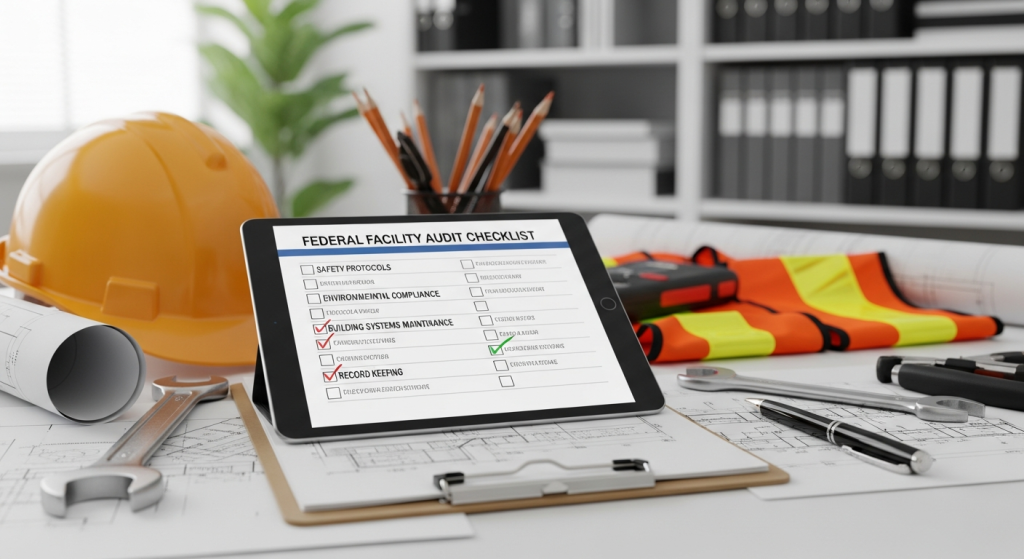
This comprehensive Federal facility audit checklist is designed to be your practical guide, a tool to help you conduct your own internal assessments, identify potential vulnerabilities, and build a more resilient, efficient, and compliant operation.
Why Audit Readiness is Critical for Federal Agencies and Contractors
A Federal facility audit serves multiple critical functions. It is designed to ensure that government buildings are safe for occupants, operationally efficient, environmentally sustainable, and fiscally responsible. For you, the facility manager, maintaining a state of readiness is paramount for several reasons:
- Risk Mitigation: Proactively identifying and correcting deficiencies prevents minor issues from escalating into catastrophic system failures or life-safety incidents.
- Operational Continuity: A well-maintained facility is a reliable facility, ensuring that the agency’s mission can continue without interruption.
- Budget Justification: A history of successful audits and well-documented maintenance provides a powerful justification for your operational and capital budget requests.
- Contractual Performance: For contractors, successfully passing audits is a key performance indicator (KPI) that can impact contract renewals and future opportunities.
Infrastructure and Critical Systems Inspection Checklist
The physical heart of your facility is its critical infrastructure. This is where auditors will begin, and it should be your top priority.
HVAC Systems and Indoor Air Quality (IAQ) Standards
- [ ] Preventive Maintenance (PM) Logs: Are your PM logs for all air handling units (AHUs), chillers, and boilers complete, up-to-date, and signed off by certified technicians? Auditors will demand these records.
- [ ] Filter Replacement Schedule: Can you provide documentation proving that all air filters have been replaced according to the manufacturer’s recommendations and ASHRAE standards?
- [ ] Indoor Air Quality (IAQ) Testing: Have you conducted periodic IAQ tests, particularly in sensitive areas, to measure factors like CO2 levels, humidity, and volatile organic compounds (VOCs)? This is increasingly a focus, aligned with GSA’s guidance on Healthy Buildings.
- [ ] Building Automation System (BAS) Audit: Is your Building Automation System properly calibrated? Are temperature and humidity setpoints aligned with federal energy efficiency mandates?
Electrical Distribution and Emergency Power Backup Systems
- [ ] Electrical Panel Inspection: Have your electrical panels, switchgear, and transformers been professionally inspected and serviced using infrared thermography to detect loose connections or overheating?
- [ ] Generator and ATS Testing: Are your emergency generator and Automatic Transfer Switch (ATS) tested weekly and under load monthly? Are the fuel levels and battery health documented? FEMA’s guidelines for backup power underscore the criticality of this system.
- [ ] Uninterruptible Power Supply (UPS) Maintenance: Are your UPS systems for critical IT and communications equipment regularly tested, and are battery replacement dates tracked?
Physical Security and Perimeter Access Control
- [ ] Access Control System Logs: Can your access control system produce a clean, clear audit trail of who accessed sensitive areas and when? Are employee and contractor access rights reviewed and updated regularly?
- [ ] Video Surveillance Functionality: Are all cameras operational? Is the video being recorded and stored for the required duration? Are camera views unobstructed?
- [ ] Emergency Communication Systems: Are your elevator and area of refuge communication systems tested and compliant with all ADA and ASME codes?
Regulatory Compliance and Safety Protocols Checklist
This section of a Federal facility audit focuses on the processes and documentation that prove you are running a safe and compliant operation.
OSHA Standards and Workplace Safety Requirements
- [ ] Hazard Communication (HazCom) Program: Is your written HazCom program up-to-date? Are all Safety Data Sheets (SDS) for chemicals used on-site readily accessible?
- [ ] Fire Protection System Inspection: Can you produce current, valid inspection and testing certificates for all fire alarm, sprinkler, and suppression systems, as required by the NFPA?
- [ ] Emergency and Evacuation Plans: Are your emergency action and fire prevention plans documented and clearly posted? Have you conducted and documented drills? OSHA’s own compliance checklists are a great starting point.
NIST Cybersecurity Framework for Facility IoT Devices
- [ ] Network Security: As your building systems (HVAC, lighting, security) become more connected, their cybersecurity becomes a physical security issue. Are these “Facility IoT” devices on a secure, isolated network?
- [ ] Password Policies: Have all default manufacturer passwords on cameras, controllers, and other networked devices been changed? This is a fundamental requirement of the NIST Cybersecurity Framework.
Preventive Maintenance Documentation and Logbook Accuracy
- [ ] Centralized Maintenance Records: Do you use a Computerized Maintenance Management System (CMMS) or a clear, organized logbook system to track all maintenance activities, work orders, and repairs?
- [ ] Vendor Certifications: Can you provide proof that all specialized work (e.g., fire alarm testing, elevator maintenance) was performed by a properly licensed and certified contractor?
Sustainability and Energy Efficiency Mandates Checklist
Federal facilities are increasingly mandated to lead the way in sustainability. Auditors will closely scrutinize your performance against these goals.
Water Conservation and Waste Management Audits
- [ ] Water Usage Tracking: Are you actively monitoring your facility’s water consumption to identify leaks or areas of inefficiency?
- [ ] Recycling Program: Is your waste management program compliant with federal and local recycling mandates? Can you provide documentation on your waste diversion rates?
Aligning with Federal Net-Zero Emissions Goals
Executive orders and federal goals are pushing agencies towards net-zero emissions. An audit will assess your progress.
- [ ] Energy Consumption Benchmarking: Are you using a tool like the EPA’s ENERGY STAR Portfolio Manager to benchmark your building’s energy performance against similar facilities?
- [ ] Renewable Energy Integration: Have you evaluated the potential for on-site renewable energy generation or procurement, in line with federal sustainability goals?
How MASE Streamlines Your Federal Facility Management and Audit Readiness
Reviewing this Federal facility audit checklist can be overwhelming. It highlights the immense complexity of managing a government building. This is precisely the challenge that MASE is built to solve. We are not just a collection of individual service vendors; we are a single, integrated facilities management partner with deep experience in the federal sector.
- Integrated Expertise: Our in-house teams of HVAC, electrical, fire protection, and security experts work in synergy. We understand how these systems interact and we manage them holistically.
- A Culture of Documentation: We are meticulous about documentation. We utilize advanced CMMS platforms to provide you with a clear, centralized, and audit-proof record of all maintenance activities.
- Local and Federal Expertise: As an SBA-certified 8(a) and Small Disadvantaged Business, we understand the unique requirements and operational environment of federal facilities in Puerto Rico.
Don’t wait for an audit notice to discover your facility’s vulnerabilities. The cost of non-compliance is always higher than the cost of preparedness. Contact MASE today to learn how our proactive, integrated facilities management services can keep your building secure, efficient, and in a constant state of audit readiness.