By the year 2026, the industrial and commercial landscape in Puerto Rico has reached a critical turning point. The traditional methods of facility management—once reactive and siloed—are no longer sufficient to protect assets in an era of energy volatility and climate intensity. Today, the conversation has moved from simply “maintaining” a building to ensuring its total resilience.
For organizations operating in Puerto Rico—especially those in the high-stakes pharmaceutical, medical device, and data center sectors—the mechanical infrastructure is the lifeblood of the operation. At MASE, we have witnessed the evolution of these facilities into Smart Buildings: ecosystems where mechanical engineering, digital monitoring, and environmental adaptability converge. This guide provides a deep dive into the standards, technologies, and strategies required to manage critical infrastructure in Puerto Rico’s unique 2026 landscape.
The Financial Reality of Manufacturing: The True Price of 1 Hour of Downtime
For industries operating in Puerto Rico, especially in regulated sectors, a stopped production line is a hemorrhaging wound to the company’s profitability. According to industry benchmarks, the cost of unplanned downtime in the pharmaceutical sector can exceed $20,000 to $50,000 per hour depending on the scale of production.
Direct vs. Indirect Costs of Failure
When a critical mechanical system fails—whether it’s a chiller, a boiler, or a specialized HVAC system—the costs ripple through the organization:
- Direct Costs: Emergency labor rates (often 2x standard), expedited shipping for parts, and wasted raw materials.
- Indirect Costs: Regulatory compliance risks (FDA/OSHA), missed shipping deadlines, and the administrative burden of rescheduling entire shifts.
Comparative Cost Analysis: Emergency Repair vs. Planned Maintenance
The logic of Preventive Mechanical Maintenance ROI is simple: spend cents today to save dollars tomorrow. A well-executed maintenance plan by MASE prevents the “firefighting” culture that drains industrial budgets.
Financial Comparison of Maintenance Strategies
Feature | Emergency Breakdown (Reactive) | Planned Maintenance (Preventive) |
Hourly Labor Rate | Premium / Emergency (High) | Contracted / Scheduled (Predictable) |
Parts Procurement | Next-day Air / Rush Fees | Inventory Managed / Pre-ordered |
Production Impact | High (Total Shutdown) | Low (Scheduled Off-peak) |
Asset Lifespan | Significantly Reduced | Maximized (Design Life +) |
Safety Risk | High (Unexpected Malfunction) | Low (Controlled Environment) |
Puerto Rico’s Environment: A Silent Tax on Your Industrial Assets
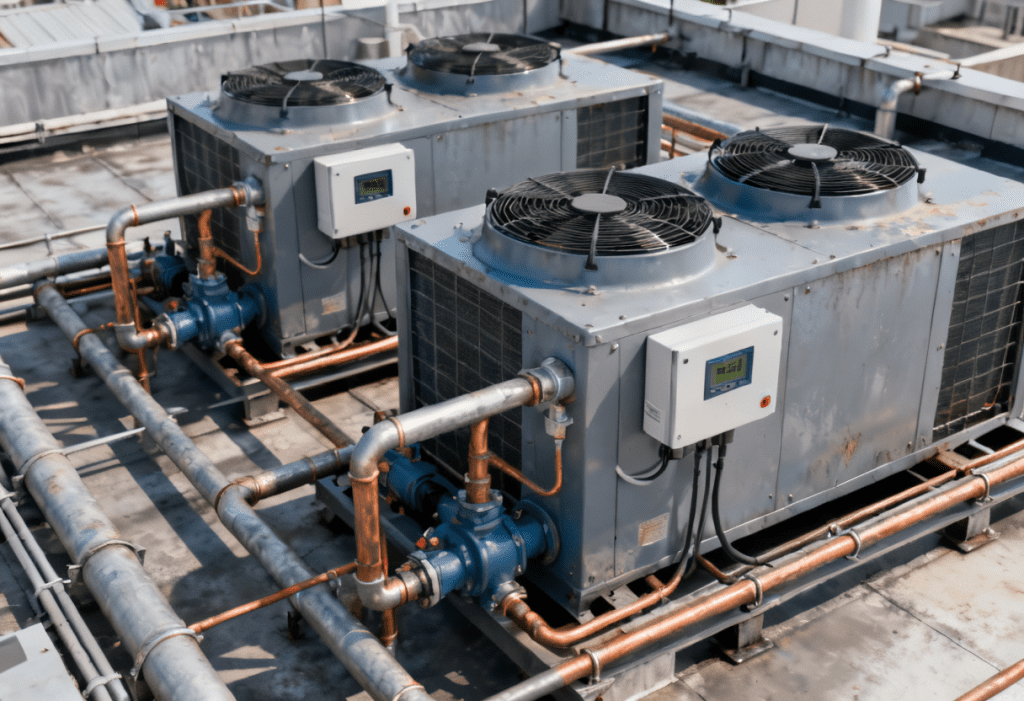
Puerto Rico presents a unique engineering challenge that most “standard” maintenance manuals don’t account for. The combination of high humidity, tropical heat, and constant salt air (salitre) acts as a relentless corrosive force on mechanical infrastructure.
Corrosion and Asset Degradation
Without a specific preventive mechanical maintenance program tailored for the Caribbean, equipment designed to last 20 years may fail in 7.
- Oxidation: Salt-heavy air accelerates the corrosion of heat exchangers and cooling towers.
- Thermal Stress: Constant high ambient temperatures mean HVAC and refrigeration units work 30% harder than in temperate climates.
- Humidity: High moisture levels lead to mold growth and electronic component failure in smart building systems.
At MASE, we don’t just maintain; we “harden” your infrastructure against the local environment, significantly extending the lifecycle of your capital assets.
Life Cycle Costing (LCC): Extending Asset Value from 5 to 15 Years
The Return on Investment of maintenance is best seen through the lens of Life Cycle Costing. When a mechanical system is properly maintained, the “Total Cost of Ownership” (TCO) drops dramatically.
The ROI of Asset Life Extension (Example: $100k Asset)
Metric | Without Preventive Plan | With MASE Preventive Plan |
Initial Investment | $100,000 | $100,000 |
Annual Maintenance Cost | $2,000 (Reactive) | $6,000 (Preventive) |
Asset Lifespan | 6 Years | 15 Years |
Replacement Frequency | 2.5 Times in 15 years | 1 Time in 15 years |
Total 15-Year Cost | $280,000+ | $190,000 |
Net Savings | – | $90,000 (47% ROI) |
Justifying the Maintenance Budget to the Board (C-Level KPIs)
To move maintenance from an “expense” to an “investment,” Facility Managers must present the right data. We recommend tracking these three KPIs:
- MTBF (Mean Time Between Failures): Increasing this number proves the effectiveness of the preventive plan.
- OEE (Overall Equipment Effectiveness): Shows how maintenance directly supports production speed and quality.
- Maintenance Cost as a % of RAV (Replacement Asset Value): Ideally, this should be between 2% and 4%.
Transforming Maintenance into a Competitive Advantage
In the competitive landscape of Puerto Rico’s 2026 industrial market, efficiency is the only way to protect margins. The cost of inaction is too high. Every day you operate without a rigorous preventive strategy, you are essentially gambling with your facility’s productivity.
MASE serves as more than a service provider; we are your strategic partner in operational excellence. We help you transition from the chaos of emergency repairs to the serenity of a high-performance, high-ROI facility.